
Artificial intelligence, automation and smart technologies are reshaping global industry, and mechanical engineering is going through one of its most important periods of transformation in recent decades. In this context, the Technical University of Moldova is moving from a traditional teaching model towards a modern academic ecosystem, aligned with European standards and new digital technologies.
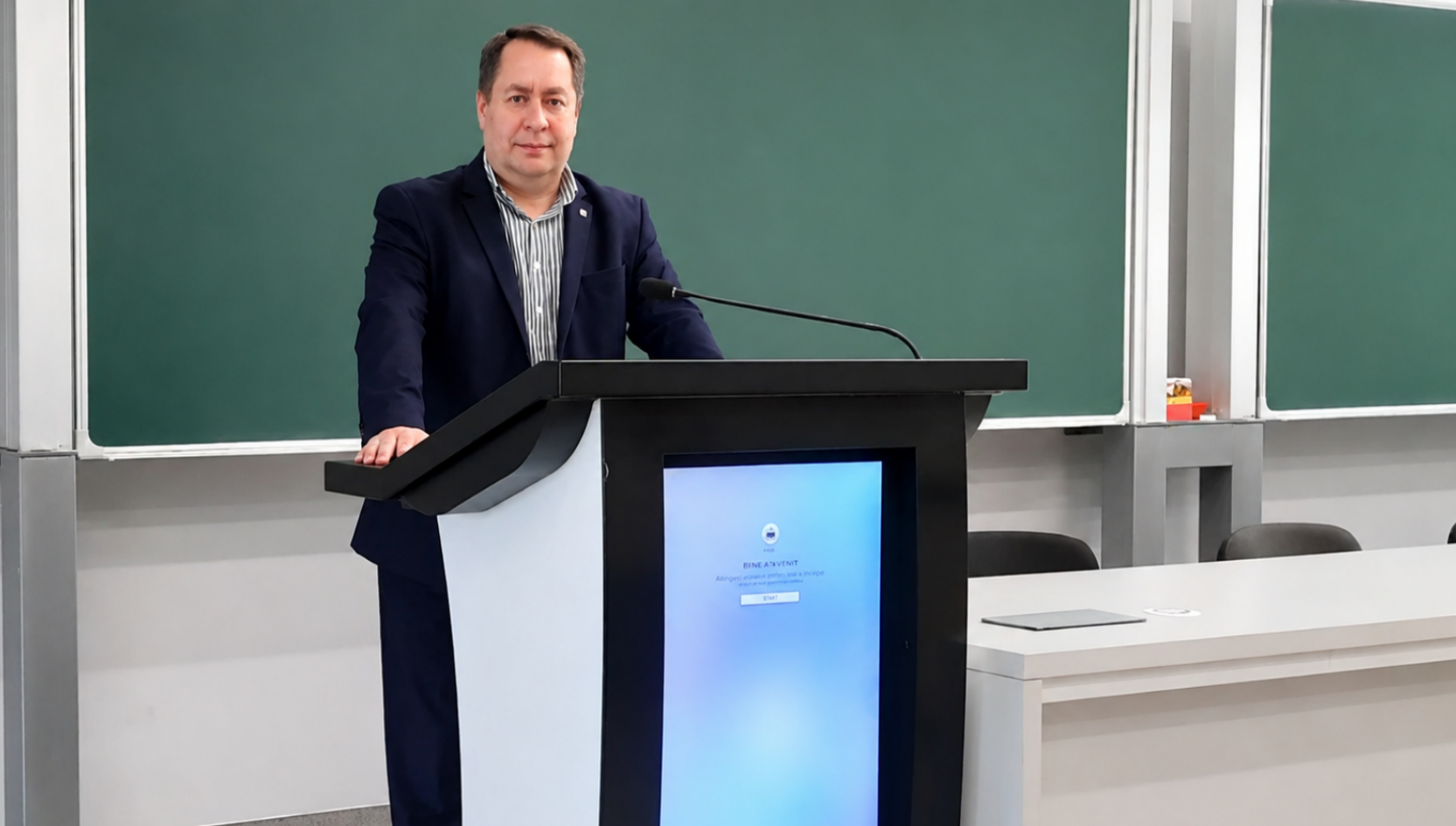
The topic was recently discussed at the UTM Senate, where Nicolae Trifan, PhD, Associate Professor and Interim Head of the Department of Machine Design Fundamentals, proposed a major change in direction: transforming the department from a classical teaching unit into a genuine regional centre for applied research and technological innovation.
This transition towards the engineering of the future has been supported by investments of more than half a million euros in infrastructure. With the support of the Ministry of Education and Research and the World Bank, three state-of-the-art laboratories were established in 2024: Strength of Materials, Materials Science and Heat Treatments. The new facilities are significantly changing the way students are trained, with a stronger focus on experimental testing, digital modelling and research activities carried out on modern equipment.
At the same time, to ensure alignment with European Union standards, the department purchased 40 European EN standards in the fields of materials science and machine components. This means that UTM students are trained according to the same norms and technical requirements used in European universities and industrial companies.
“Mechanical engineering is no longer only about technical drawing and metal processing. Today, a high-performing engineer must be part programmer and part data analyst. The modernisation of our laboratories and the transition to European standards are not merely administrative objectives, but a vital necessity. We are giving students the tools of the present so that they can design the technologies of the future. We are no longer training simple executors; we are educating innovators for a global market,” says Nicolae Trifan, PhD, Associate Professor and Interim Head of the Department of Machine Design Fundamentals.
The modernisation of infrastructure is also redefining the profile of the new engineer, where traditional mechanics is complemented by digital skills and AI-based tools. The department’s research activity, coordinated by well-known figures such as Academician Ion Bostan, is focused on strategic areas for the 2021–2026 period: the development of precessional transmissions and high-performance actuation mechanisms, mechanical systems and magnetic transmissions, renewable energy conversion, mathematical modelling of material behaviour, and the optimisation of centrifugal pumping using CFD methods and AI-based algorithms.
This last direction reflects the profile of today’s engineer: a specialist able to simulate complex processes digitally, interpret large volumes of data and use AI to optimise technological performance. The results achieved confirm the department’s progress: in recent years, six monographs and four textbooks have been published, and two doctoral theses in engineering sciences have been defended.
“A strong engineering school is not built overnight, but through continuity and constant adaptation. During the nearly 25 years in which I had the honour of leading UTM, I always believed that the university must stay one step ahead of its time. What the Department of Machine Design Fundamentals is achieving today is a natural continuation of that vision: we preserve the rigour of the traditional engineering school and integrate it into the digital and AI era. The generational renewal we are seeing today gives confidence in a solid future for Moldovan engineering,” says Academician Ion Bostan, the rector who shaped UTM’s history for almost a quarter of a century.
UTM’s strategy for 2026–2031 further strengthens this development direction through a programme built around three essential pillars:
The first pillar focuses on developing an interactive curriculum based on applied learning, teamwork and the solving of real problems from industry.
The second pillar is oriented towards generational renewal and attracting young researchers, including through the recent employment, in 2025, of a young master’s student in engineering, with the prospect of continuing doctoral studies.
The third pillar aims to strengthen the relationship with industry through the collaborations initiated with the Institute for Standardization of Moldova and the development of technical expertise and validation services for companies.
These directions respond to the expectations of a new generation of students who are looking for access to modern technologies, digital skills and training opportunities comparable to those on the European market. The transformation is already visible in concrete results: the 58 recent academic mobilities completed by teaching staff at universities in Romania, Spain, Poland and Bulgaria demonstrate the department’s international openness and its integration into the European area of education and research.
At the same time, UTM is working on the development of a new international master’s programme in partnership with institutions from Spain and Romania, while students are being involved in applied research projects from their years of study, including through the “Young Researchers 2025–2026” programme.
Today, the “fundamentals” of engineering at UTM no longer mean only strength of materials or the design of machine components. They also include interdisciplinary skills that bring together mechanics, digital simulations, artificial intelligence and energy efficiency. Through this new approach, UTM trains specialists capable of contributing to the economic competitiveness of the Republic of Moldova and to the development of future technologies.


