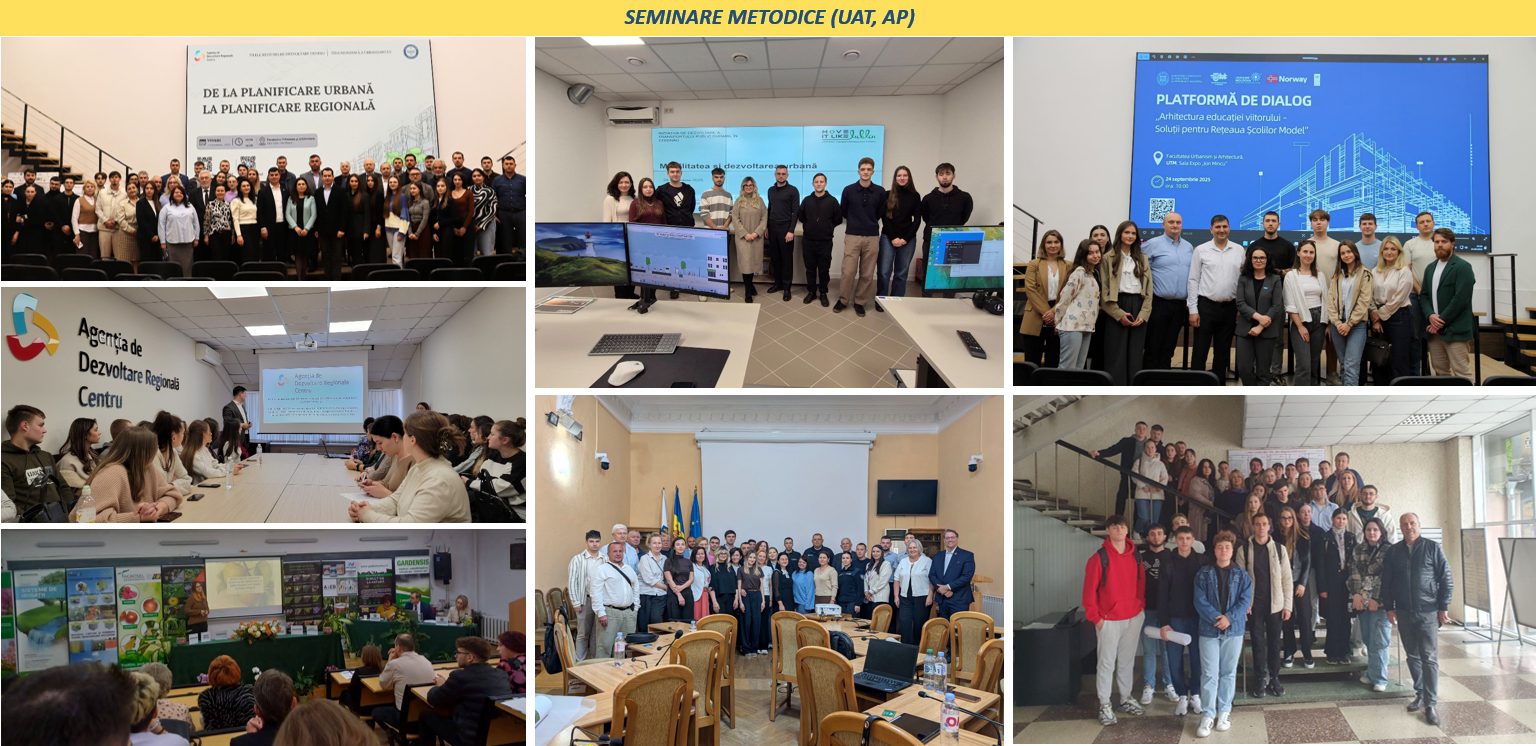

What does it truly mean to build a well-designed city, one in which we would all wish to live? Is urban planning merely an arrangement of streets and buildings, or is it a living expression of balance between people, space, and the future? At the Technical University of Moldova, urban planning is seen as an art of responsibility and vision, and this philosophy takes shape through the work of the Department of Urban Planning and Urban Design (UDU). The 2021–2026 activity report, presented by the head of department, Dr., Lect. Liliana Platon, and evaluated by the UTM Senate with the rating “very good,” confirms a steady evolution from academic theory to tangible results with real impact on the built environment.
But how is performance measured in a field that shapes the future of cities? First and foremost, through solid research and continuous connection to the pulse of international academic work. Over the past five years, the scientific activity of the UDU team has not remained confined to classrooms. Instead, it has ensured consistent visibility in prestigious databases such as Web of Science and SCOPUS. With 14 high-level articles, 66 works published in international scientific anthologies and conference proceedings, and 20 articles appearing in journals from the National Register, UDU researchers demonstrate that solutions developed in Chișinău resonate globally.
Is it still meaningful to teach creativity using outdated methods? Clearly not. That is why the key question became: how can educational resources keep pace with rapid technological change? The answer lies in the development of 11 new teaching materials, which allowed the Interior Design program to become the flagship of the department’s academic offer. Today, students do not simply learn design—they experience it through projects aligned with the present needs of society.
Faculty members are deeply involved in national strategies for safeguarding architectural heritage, construction digitalization, and improving energy efficiency. In this way, urban planning taught at UTM does not remain locked between the pages of textbooks but becomes a driving force behind the country’s “green transformation.” In practical terms, the reporting period saw significant scientific achievements. Doctoral dissertations and published monographs—such as Dr. Liliana Platon’s studies on figurative imagery in national painting or Dr. Tatiana Filipski’s research on museum pedagogy—reveal the department’s multidisciplinary profile, where urban planning continuously interacts with art, culture, and education. Meanwhile, the doctoral school has strengthened, with the number of researchers in advanced stages of study steadily increasing.
International openness has become essential for UDU. Through partnerships with universities in Timișoara and Kyiv, and through Erasmus+ mobilities, more than 65 scientific event participations have brought the best European practices into UTM lecture halls. Beyond this, another question emerged: how can we shorten the distance between university and the first job? The solution was closer synergy with industry, providing students with internships where “the craft” is learned directly from top professionals.
Who are the architects behind this success? The secret seems to lie in balance: a dynamic infusion of energy from young professionals supported by the vast experience of senior colleagues. This intergenerational dialogue has strengthened the doctoral school, where five researchers are already in advanced phases of their work, preparing solutions for tomorrow’s sustainable cities.
All these efforts are reflected in the consolidation of the study programs in Interior Design, Urban Planning, and Landscape Architecture, which have become benchmarks in Moldova’s design and planning education. At the heart of this success is a dynamic team in which experience blends harmoniously with the energy of the new generation and with modern design technologies.
The 2021–2026 review makes one thing clear: the Department of Urban Planning and Urban Design has grown not only in numbers—it has built a strong, modern identity, fully connected to contemporary realities. And if you are wondering what comes next, the answer is simple: a new phase of expansion, in which our projects will continue transforming Moldova’s cities into smart, sustainable, people-focused environments.
At UTM, urban planning is not merely studied—it becomes, day by day, a driving force of the future.