

The transition to sustainable energy sources has become a global priority, and solid biofuels represent a viable alternative to fossil fuels. They help reduce carbon emissions, enhance energy security, and create new economic and technological opportunities. But how can biofuels reshape the future of energy? What challenges come with their implementation? And what role does agriculture play in this process?
Beyond providing essential food products, agriculture is also a key source of renewable energy. In the context of the current energy crisis, the solid biofuels sector is emerging as a strategic component for Moldova’s national economy and energy security. Using agricultural waste to produce solid biofuels presents a significant opportunity. Biomass residues from farming activities can be processed into pellets and briquettes, which can then be used for heating homes, powering thermal plants, and supporting industrial processes.
According to data from the National Center for Sustainable Energy, over 300 public institutions in Moldova already use biomass for heating. However, its adoption in the residential sector remains relatively low. While firewood continues to be the primary fuel for many households, solid biofuels offer a more accessible and sustainable alternative. In 2024, thanks to a program implemented by UNDP Moldova and funded by the Government of Japan, ten local biofuel producers received grants to expand their businesses and modernize their equipment. Despite this progress, the sector still faces challenges such as price fluctuations and inconsistent fuel quality. To ensure higher product standards, the government has approved a new regulation on solid biofuels, aligning with European standards.
The Technical University of Moldova plays a crucial role in the research and development of solid biofuels. The university’s Scientific Laboratory for Solid Biofuels conducts studies to improve fuel quality and identify the most efficient biomass resources.
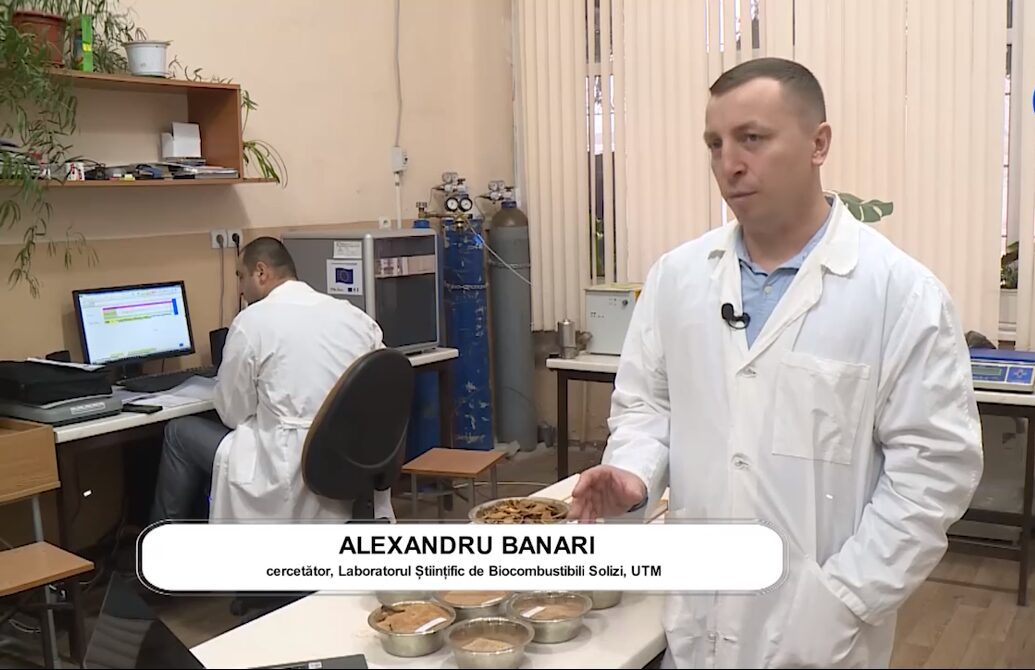
Alexandru BANARI, a researcher at UTM’s Scientific Laboratory for Solid Biofuels:
– Solid biofuels can be used in automatic stoves that allow for efficient fuel management—a fully loaded stove can operate for 2-3 days. Although traditional stoves are not designed for this type of fuel, there are technical solutions available to convert them.
The UTM research team has analyzed various plant species and found that dog rose (Rosa canina), gooseberry (Ribes uva-crispa), and sea buckthorn (Hippophae rhamnoides) have high energy potential. For example, dog rose provides a calorific value of approximately 20.7 megajoules (MJ), ensuring efficient combustion with low ash content.

Grigore MARIAN, head of UTM’s Scientific Laboratory for Solid Biofuels:
– Agricultural efficiency means making full use of available resources. For instance, walnut shells and dried grapevines can be repurposed as effective heat sources. However, to meet quality standards, these materials need to be combined with other types of biomass.
A previous project, “Energy and Biomass,” initially brought together around 140 producers of briquettes and pellets, but this number dropped to about 80 when gas prices were low. As gas costs rise again, interest in solid biofuels is making a comeback, positioning them as a viable alternative to traditional energy sources.
UTM specialists emphasize that while solid biofuel production cannot fully meet Moldova’s energy needs, utilizing renewable biomass is a key element of national energy security. Diversifying energy sources and supporting local producers could accelerate the country’s transition toward energy independence.
Through research, innovation, and well-structured policies, solid biofuels can become a long-term solution for a more sustainable energy system, reducing reliance on conventional fuel sources.