










Cosmic radiation remains one of the greatest challenges for satellites and electronic systems operating in space. Under certain conditions, a single high-energy particle can disrupt the functioning of a critical electronic component. How can these phenomena be detected and analyzed in real time to protect space missions? The answer is emerging through a collaboration between the Technical University of Moldova and Transilvania University of Brașov (UniTBv), where researchers are developing intelligent sensors that combine FPGA technology with artificial intelligence algorithms.
These guiding questions shaped the recent research mobility of UTM scientists to UniTBv. The answers are found not only in numbers and diagrams but in the synergy between top experts from both institutions, brought together under the international project AICoRS (Artificial Intelligence-enabled Hardware Cosmic Radiation Sensor for Space Applications). At the center of this technological transformation stands a dedicated team of specialists who are turning theoretical research into a tangible shield against the invisible threats of outer space.
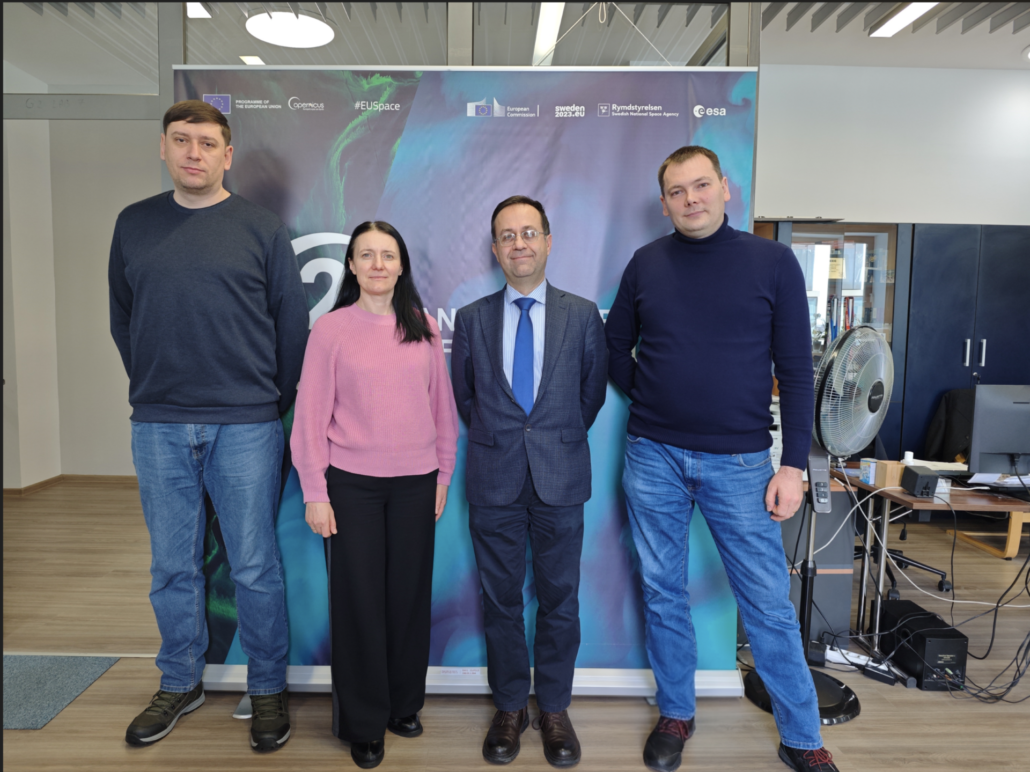
The scientific discussions in Brașov brought together dr. Viorel Cărbune, dr. Mariana Rusu and dr. Vladimir Melnic from UTM with the host team coordinated by prof. dr. ing. Mihai Ivanovici, alongside researchers Ștefan Popa and Andrei Bertescu. Their collaboration focused on a genuine hardware revolution in space technology and the advantages of FPGA systems, which form the backbone of the project. The dialogue sought to answer a key question: why is this approach considered the future, surpassing classical microprocessors? Unlike standard processors that execute instructions sequentially and are vulnerable to high-energy particle strikes that can corrupt data, FPGAs allow for the configuration of logic circuits directly at the hardware level. This architecture offers massive parallelism that is essential for real-time data processing, as well as valuable reconfigurability that allows adjustments even after the device has left Earth’s atmosphere. Moreover, FPGA architecture supports advanced error-tolerance mechanisms for radiation-induced faults, which are crucial for stable operation in space.
The AICoRS concept and testing of the “Flight” model of the sensor highlight a new generation of intelligent devices capable not only of detecting radiation but also of instantly classifying it using artificial intelligence. During the mobility period, researchers focused on rigorous testing of the model intended for spaceflight, a process that required careful optimization of the architecture to balance minimal energy consumption with maximum performance. Integrating AI algorithms directly onto the chip allows for rapid analysis of sensor-generated data and increases system reliability in the complex environment of space. This fusion of flexible hardware and intelligent software provides the protective shield that future satellites will need.
The tangible results of this collaboration extend beyond the technical domain, taking shape in the advancement of intelligent sensor solutions and the strengthening of a long-term knowledge bridge between Chișinău and Brașov. It is a strategic partnership that shows how scientific frontiers can be pushed only through joint effort, accelerating technology transfer and opening new opportunities for funding through prestigious European programs, including those of the European Space Agency (ESA).
By training highly specialized experts in niche fields, UTM reaffirms its status as a regional hub of expertise. The importance of such partnerships lies in their ability to transform bold visions into technological realities, demonstrating that the Technical University of Moldova is ready to meet the challenges of the “New Space” era and contribute meaningfully to future space exploration.


